The Union Public Service Commission (UPSC) conducts the Civil Services Examination (CSE) annually to select officers for India’s top administrative services, including the Indian Administrative Service (IAS), Indian Police Service (IPS), and Indian Foreign Service (IFS).
For any beginner, entering the world of UPSC preparation can feel intimidating due to the sheer vastness of the exam. However, every successful journey starts with a clear understanding of the exam’s blueprint. The selection process comprises three distinct stages:
- Preliminary Examination (Prelims) – Objective-type screening test.
- Main Examination (Mains) – Descriptive written examination testing in-depth conceptual clarity.
- Personality Test (Interview) – Final conversational assessment evaluating public service suitability.
The UPSC Prelims acts as the initial gateway or screening test to filter candidates for the Mains examination. Marks scored in the Prelims do not count toward your final merit ranking; its sole purpose is to determine eligibility for the Mains.
UPSC Prelims 2027: Key Official Dates and Timeline
For aspirants planning their attempt for the UPSC CSE 2027 cycle, UPSC releases an annual calendar to give candidates adequate preparation time.
| Key Examination Event | Official Scheduled Date |
|---|---|
| Official Notification Release Date | January 13, 2027 |
| Start of Online Application | January 13, 2027 |
| Application Deadline | February 02, 2027 |
| UPSC Civil Services Preliminary Exam 2027 | May 23, 2027 (Sunday) |
| UPSC Civil Services Main Exam 2027 | August 20, 2027 (5 Days duration) |
(Note: The Indian Forest Service (IFoS) Preliminary Examination is conducted jointly through the Civil Services Preliminary Examination.)
These dates come from the UPSC Annual Calendar 2027, released in May 2026. The official notification, due on January 13, 2027, confirms them, so please check it at upsc.gov.in.
UPSC Prelims Exam Pattern & Marking Scheme Explained
The Preliminary Examination consists of two compulsory objective-type papers conducted on the same day in offline (OMR) mode. Questions are provided in both English and Hindi.
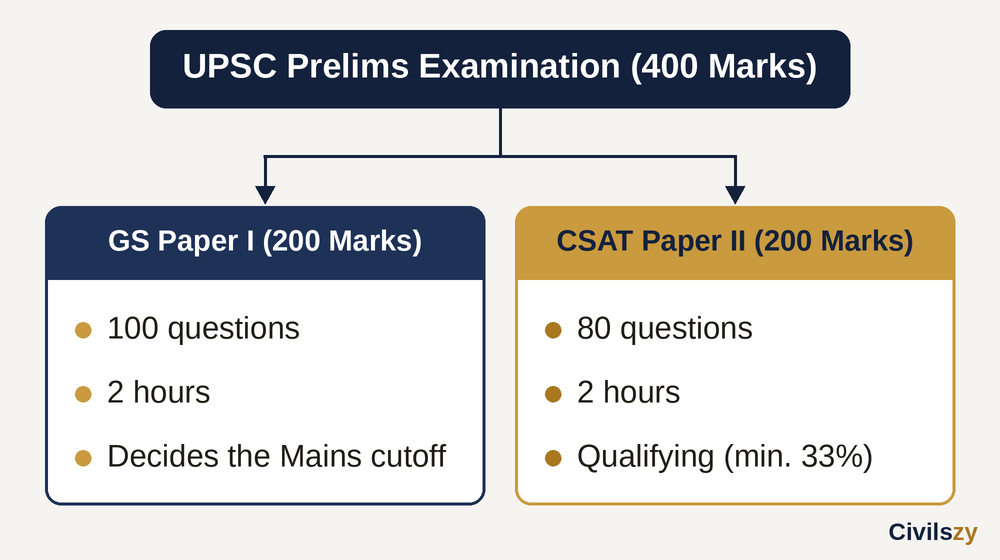
Complete Structure of Prelims Papers
| Feature | General Studies Paper I (GS Paper 1) | General Studies Paper II (CSAT) |
|---|---|---|
| Number of Questions | 100 Questions | 80 Questions |
| Total Marks | 200 Marks | 200 Marks |
| Duration | 2 Hours | 2 Hours |
| Marks per Question | 2.0 Marks | 2.5 Marks |
| Negative Marking | 1/3rd penalty (~0.66 marks per wrong answer) | 1/3rd penalty (~0.83 marks per wrong answer) |
| Role in Selection | Determines Prelims Merit Cut-off for qualifying to Mains | Qualifying Paper — Requires minimum 33% (66 Marks) |
Crucial Exam Pattern Rules Every Beginner Must Know
- Compulsory Attendance: Candidates must appear in both papers; missing either paper results in automatic disqualification.
- Negative Marking: One-third (1/3) of the marks assigned to a question are deducted for every wrong answer. Unattempted questions carry no penalty. Marking multiple options for a question is treated as a wrong answer.
- CSAT Rule: The CSAT paper is strictly qualifying. If a candidate fails to score 33% (66 marks out of 200) in CSAT, their GS Paper I is not evaluated for cutoff merit.
Detailed Breakdown: General Studies Paper I (GS Syllabus)
GS Paper I evaluates general awareness, conceptual understanding, and factual accuracy across core social science, scientific, and ecological disciplines.
1. Current Events of National and International Importance
- Core Topics: Flagship government schemes and welfare policies, national initiatives, constitutional amendments, judgments, reports and global indices, international summits (G20, BRICS, UN, ASEAN), awards, and emerging science developments.
- Beginner Tip: Connect static concepts from your textbooks directly with developments reported in national daily newspapers.
2. History of India and Indian National Movement
- Ancient India: Indus Valley Civilization, Vedic age, Buddhism & Jainism, Mauryan and Gupta Empires, Sangam period, and early art/architecture.
- Medieval India: Delhi Sultanate, Mughal Empire, Vijayanagara Kingdom, and Bhakti & Sufi cultural movements.
- Modern India & Freedom Struggle: British colonial policies, Revolt of 1857, socio-religious reforms, Swadeshi & Home Rule movements, Gandhian era (Non-Cooperation, Civil Disobedience, Quit India), and constitutional evolution up to 1947.
3. Indian and World Geography
- Physical Geography: Earth structure, geomorphology (volcanoes, earthquakes), climate systems (monsoons, cyclones, El Niño), atmosphere, hydrosphere, and soils.
- Indian Geography: Physiographical divisions (Himalayas, plains, peninsular plateau), river systems, agriculture, mineral/energy resources, transport, and demographic patterns.
- World & Human Geography: Continents, major mountain ranges, oceans, global climate zones, and natural resource distribution.
4. Indian Polity and Governance
- Constitutional Framework: Historical evolution, Preamble, Fundamental Rights, Directive Principles of State Policy (DPSP), Fundamental Duties, and Amendments.
- Political & Administrative Architecture: Union Executive (President, Prime Minister, Cabinet), Parliament, State Legislatures, Judiciary (Supreme Court, High Courts), and Panchayati Raj / Urban Local Bodies.
- Bodies & Rights Issues: Election Commission, CAG, Finance Commission, UPSC, NITI Aayog, statutory bodies, public policies, e-governance, and transparency measures (RTI).
5. Economic and Social Development
- Macroeconomic Fundamentals: GDP/GNP, inflation, fiscal policy, monetary policy (RBI roles), banking architecture, taxation, and government budget.
- Social Sector & Inclusion: Sustainable development goals, poverty metrics, demographic trends, unemployment, health and education schemes, and financial inclusion initiatives.
6. Environmental Ecology, Biodiversity, and Climate Change
- Ecosystem Dynamics: Basic ecological principles, food chains, trophic levels, and ecological pyramids.
- Biodiversity Conservation: Species preservation, national parks, wildlife sanctuaries, biosphere reserves, and global conventions (Paris Agreement, CBD, CITES).
- Environmental Challenges: Climate change, global warming, pollution mitigation, renewable energy, and environmental legislation.
7. General Science
- Basic Sciences: Foundational concepts in Physics, Chemistry, and Biology (human health, nutrition, diseases).
- Modern Science & Technology: Space technology (ISRO missions), defense developments (DRDO), biotechnology (GM crops, gene editing), information technology, artificial intelligence, robotics, and nanotechnology.
Detailed Breakdown: General Studies Paper II (CSAT)
The Civil Services Aptitude Test (CSAT) evaluates analytical skills, logical decision-making, and comprehension abilities.
Topic-Wise CSAT Syllabus
- Comprehension: Passages assessing reading speed, critical thinking, inference extraction, and analytical reading skills.
- Interpersonal & Communication Skills: Contextual decision-making and communication scenarios.
- Logical Reasoning and Analytical Ability: Deductive logic, syllogisms, coding-decoding, series completion, blood relations, and seating arrangements.
- Decision-Making and Problem-Solving: Situation-based decision scenarios.
- General Mental Ability: Puzzles, direction tests, Venn diagrams, and spatial reasoning.
- Basic Numeracy (Class X Level): Number systems, percentages, ratios & proportions, averages, profit & loss, simple/compound interest, and time & work.
- Data Interpretation (Class X Level): Charts, graphs, tables, bar diagrams, pie charts, and data sufficiency problems.
- English Language Comprehension (Class X Level): Tested through passages in English only, without a Hindi translation.
UPSC Eligibility Criteria: Quick Check for Beginners
Before starting preparation, ensure you meet the basic eligibility conditions established by UPSC:
- Educational Qualification: A Bachelor’s degree from any recognized university. Final-year undergraduate students can apply for the Prelims, provided they submit proof of passing before writing the Mains exam.
Age limit (as of August 1 of the examination year) and number of attempts:
| Category | Age Limit | Maximum Attempts |
|---|---|---|
| General / EWS | 21 to 32 years | 6 |
| OBC | 21 to 35 years | 9 |
| SC / ST | 21 to 37 years | Unlimited (within the age limit) |
| PwBD | Up to 10 additional years of age relaxation, based on category | 9 for General / OBC; unlimited for SC / ST (within the age limit) |
For the full eligibility rules and the services you can join, read What is UPSC Civil Services Examination?
Preparation Strategy for Beginners: Master the 5R Framework
To navigate the vast UPSC Prelims syllabus effectively, beginners can adopt a structured 5R Framework:
- Read the Syllabus & PYQs First: Keep a soft or printed copy of the official syllabus at your desk. Analyze at least 5–10 years of Previous Year Question Papers (PYQs) to understand question depth and option elimination patterns.
- Root Concepts with NCERTs: Build foundational knowledge by reading standard NCERT textbooks (Classes 6 to 12) across History, Geography, Polity, Economy, and Science before jumping to advanced reference guides.
- Restricted Source Selection: Stick to one standard book per subject (e.g., M. Laxmikanth for Polity, Spectrum for Modern History). Avoid collecting multiple books for a single topic.
- Regular Revision Cycles: Retaining information requires periodic review. Create short bullet notes or mind maps for key articles, facts, and schemes.
- Routine Practice & Mock Analysis: Practice full-length and sectional test series regularly to build speed, accuracy, and time management under negative marking pressure. Assess CSAT strength early in your study plan rather than postponing it to the final weeks.
Frequently Asked Questions (FAQs)
Q1. Is the UPSC Prelims mark included in the final rank list?
No. The Preliminary examination is strictly a screening test. Final selection and ranking depend exclusively on the combined marks of the Mains Examination (1750 marks) and the Personality Test / Interview (275 marks), totaling 2025 marks.
Q2. How many marks are needed to clear the CSAT paper?
Candidates must score a minimum of 33% in CSAT, which translates to 66 marks out of 200.
Q3. How does negative marking work in UPSC Prelims?
For every incorrect answer, one-third (1/3rd) of the marks assigned to that question are deducted. In GS Paper 1, each wrong answer costs 0.66 marks, while in CSAT, each wrong answer costs 0.83 marks. Unattempted questions carry zero penalty.
Next step: once you are comfortable with the Prelims syllabus, continue with the UPSC Mains Syllabus.
Please note: UPSC can revise the syllabus, the exam pattern and the dates. Always confirm the latest details in the official notification at upsc.gov.in before you plan your preparation.